What Diseases Can a Baby Get From Breastfeeding
Managing Poor Weight Gain in Your Breastfed Baby
Sometimes, a breastfed baby will proceeds weight more slowly than he or she should. This could be because the female parent isn't making plenty milk, the baby can't get enough milk out of the chest, or the baby has a medical problem. Your baby's healthcare provider should evaluate whatsoever instance of poor weight proceeds. Often, a certified lactation consultant can help. Below are some general tips for addressing poor weight gain in a breastfed infant.
Check the schedule
-
Lookout man for signs from your baby that he or she wants to feed. Your infant should wake and "cue" to breastfeed well-nigh 8 to 12 times in 24 hours by rooting, making licking or sucking motions, bobbing his or her head or bringing his or her hand to the face up or rima oris. It is of import for you to recognize these feeding cues and put your baby to your breast when he or she cues. Don't wait for your baby to cry. Crying is a tardily feeding cue. Usually a baby latches and breastfeeds meliorate if he or she does not have to wait until he or she is crying, frustrated, or too tired to feed. Putting a babe off to try to become the infant to go longer betwixt feedings and frequently offering a pacifier instead of the breast when a babe demonstrates feeding cues are often linked to poor weight gain.
-
Many mothers detect milk production increases and babies' weight gains improve if they and their babies allow chores and activities get for 2 or 3 days, so they tin breastfeed, more or less, around the clock. When a baby is not breastfeeding, the mother holds him or her skin-to-skin on her chest, which often helps her go more sensitive to the infant'southward feeding cues.
-
If your baby is a "sleepy" baby who does not cue to feed at least 8 times in 24 hours, you lot volition have to wake the baby to feed often--about every ii hours during the daytime and evening hours and at least every 3 to iv hours at nighttime until weight gain improves.
-
Information technology can help to write downwardly when your baby nurses, on which side, and for how long for a full 24 hours, if not longer. Take this record to your healthcare provider or lactation consultant to assistance notice and ready the problem.
Latching and positioning
-
Exist sure your baby is mainly uncovered during breastfeeding. A baby that is bundled papoose-mode may get much too warm and comfy, and he or she is more probable to doze off too quickly during feedings. If there is a chill in the air, drape a sheet or calorie-free blanket over you and the baby, as needed.
-
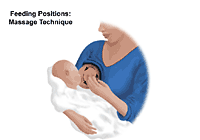
If your baby falls asleep within minutes of latching on, massage your breast every bit he or she nurses. This can provide a outburst of milk and re-trigger sucking. You can do this by stroking downward and inward on the breast.
-
Make sure your baby is latching on correctly. The latch should exist comfortable to you. Your baby'due south lips should be flanged outward like "fish lips." The tongue should be under your breast. A large amount of your breast tissue should be in the baby'due south rima oris.
-
In general, avoid "switch nursing." That is, breastfeeding at one breast for a few minutes, then the other, and so dorsum over again. This may interfere with your infant getting enough of the calorie-rich hindmilk, which your babe gets more than of as a feeding continues on i chest. Yet, the "switch" strategy sometimes stimulates the "sleepy" baby and so he or she wakes up and starts sucking again.
If your healthcare provider recommends supplementing
-
Apply your ain expressed milk first for whatsoever culling feedings.
-
Utilize an alternative feeding method if it is recommended past your healthcare provider or a certified lactation consultant (IBCLC). In that location are many alternative feeding options, so permit them know if a recommendation does non "feel right" for you. Alternative feeding methods include:
-
Loving cup feeding
-
A tube system with a special feeding tube taped to the breast or a finger (Supplemental Nursing System, or SNS)
-
Syringe feeding
-
An eyedropper
-
Spoon-feeding
-
Bottle-feeding
-
-
Several methods crave assistance from a professional, such as a certified lactation consultant (IBCLC) then you can use them correctly. Depending on your baby and the cause of the problem, some methods may piece of work better than others. Too, talk over bottle nipple type with the IBCLC if you canteen-feed any supplement. Some types of bottle nipples are less likely to interfere with breastfeeding than others.
Maintaining or increasing your milk supply
-
Pump your breasts after as many daily breastfeedings as possible, peculiarly if you are uncertain whether your baby is effectively removing milk during breastfeeding. Many women notice that trying for 8 times per 24-hour interval is manageable and helpful for their milk supply.
-
Pumping will remove milk effectively, so your breasts will know to make more milk. Pumping will likewise express supplemental milk for feeds. Milk tin can be removed from the breast by transmission paw expression, a hand pump, a battery-powered pump, or an electric breast pump. If frequent and prolonged pumping is anticipated, a hospital-grade, electrical pump can be very helpful.
Checking baby's weight
-
Your infant should be weighed on a frequent and regular basis until he or she is gaining weight at a satisfactory rate. Digital scales are available that permit a healthcare provider or a certified lactation consultant (IBCLC) to go precise pre- and post-feeding weights to measure how much milk a baby takes in during a particular breastfeeding. Although this can be helpful, babies take in different amounts at different feedings throughout a 24-hour period. Therefore, a professional may recommend that parents hire this type of scale so a baby tin exist weighed before and after different feedings. They also may suggest recording only a daily or weekly weight, depending on the situation.
Call your infant's healthcare provider
If your baby ever shows signs of dehydration, call your babe'south healthcare provider correct abroad. Some signs of dehydration in a infant include:
-
Fewer stools and moisture diapers than usual
-
Dry out lips
-
Sunken fontanelle (soft spot)
-
Dark circles around the eyes
-
Actualization more tired than usual
If breastfeeding is properly managed, still the baby still is not gaining enough weight, information technology is likely that some other factor is affecting milk production or the infant's ability to breastfeed effectively. Always consult your ain, and your baby's healthcare provider.
Source: https://www.hopkinsmedicine.org/health/conditions-and-diseases/breastfeeding-your-baby/mismanaged-breastfeeding
0 Response to "What Diseases Can a Baby Get From Breastfeeding"
Postar um comentário